

Title: Three Event Video Setups for a Product Launch
A product launch can generate a keynote recording, demonstration clips, customer reactions, executive interviews, social edits, and a polished recap-but only if the coverage plan reflects what happens once the event ends. Buying the largest crew is not automatically the answer. The useful choice is the smallest production setup that can protect the non-repeatable moments and deliver the formats the launch team has already promised to its channels.
First define the launch’s centre of gravity
Some launches revolve around an announcement on stage. Others depend on hands-on demonstrations, invited customers, media interviews, or the atmosphere around a brand activation. List the moments that happen once and the moments that can be recreated. A keynote reveal cannot be recovered if audio fails. A clean product close-up may be captured in a controlled session before doors open. That distinction should shape the crew and schedule.
Also decide which audience matters after the room. Sales prospects may need a concise demonstration. Partners may want an executive explanation. Social viewers may respond to energy and reaction. Internal teams may need the complete presentation. Those uses can share source material, but they require different framing and sound.
Option one: focused stage and demonstration coverage
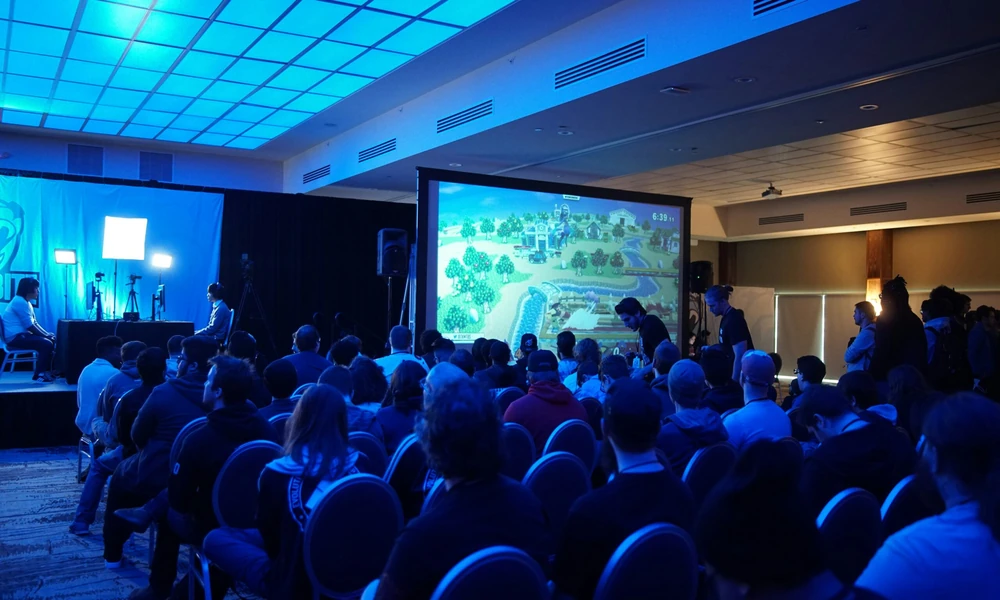
This setup concentrates on the formal program: a dependable stage angle, direct audio, demonstration details, and enough room context to establish the event. It suits a launch with a short agenda, a controlled venue, and one primary long-form deliverable. A second camera may cover reactions or protect edits while the main camera stays on the speaker.
The advantage is concentration. Time and budget go toward sound, exposure, and complete coverage of the announcement. The tradeoff is limited variety for social or campaign edits. If every output needs a different human story, one stage-focused team may spend the day protecting the keynote and miss conversations elsewhere.
Option two: stage coverage plus a roaming story unit
A roaming operator can capture arrivals, demonstrations, customer questions, brand details, and short reactions while the stage unit remains in position. This works when the value of the launch includes both the announcement and the response around it. The schedule should identify where the roaming camera must be during the reveal so the two units do not accidentally cover the same view.
Teams considering event videography services from Indigo Visual can assess whether this division matches their program. Ask how audio will be handled away from the stage, who will identify useful interview subjects, and how footage from separate areas will be organized for editing.
Option three: an integrated launch-content production
The broadest setup treats the event as one part of a larger content day. It may include pre-event executive interviews, controlled product footage, stage coverage, roaming event video, and still photography. It makes sense when the launch must supply assets for several teams and when access to products, leaders, or a designed venue is unusually valuable.
Integration requires more pre-production, not less. Lighting for an interview cannot simply occupy a busy demonstration zone. Product scenes need an owner who can prepare the correct unit. Executives need protected times away from press and guests. A shared shot ledger should show which deliverable each setup supports. For launches with a substantial business narrative, Indigo Visual’s business videography page offers a useful comparison for the controlled interview and brand-story side of the plan.
Use a simple buying test
- Choose focused coverage when the announcement is the asset and the formal program contains nearly all the value.
- Add a roaming unit when reactions, demonstrations, and the event environment are essential to the story.
- Build an integrated production when the launch must also create a longer-lived campaign library and access is difficult to reproduce.
Whichever option fits, specify audio feeds, must-capture times, product handling, permissions, aspect ratios, delivery priorities, and one person who can make decisions on site. Keep a fallback for schedule changes. If a keynote runs long, the team should know whether the next priority is an executive interview, customer reaction, or controlled product footage.
Plan graphics before the event as well. Product names, executive titles, launch dates, and feature language should arrive in an approved source file. Editors should not have to copy critical wording from a slide photographed at an angle. If the announcement includes a date-sensitive offer or claim, request a clean alternate version so useful footage is not permanently tied to a short promotional window.
Delivery speed should be purchased deliberately. A same-day social edit requires an editor, approved music or sound, a fast transfer path, and a stakeholder who can respond while the event is still underway. Without those resources, “same day” becomes a rushed promise that competes with primary coverage. A next-morning cut may serve the campaign better if it allows accurate names, balanced scenes, captions, and a clean review.
Once the first versions are released, preserve a clean master without date-sensitive graphics. Store the approved product language, captions, and music details with it. The launch may be over, but demonstrations, executive explanations, and well-shot reactions can support follow-up communication when their context is easy to verify.
A launch is full of visual possibilities, but useful coverage is selective. Protect the moments that cannot happen again, then spend remaining effort on material with a named destination. That approach produces a smaller, stronger library than recording every corner of the event without deciding what the footage is for.